Marine operators have long accepted a cycle of stripping, rebuilding, and recoating underwater metal as standard practice. For decades, multi-layer antifouling systems have dominated the industry, built on sacrificial wear, chemical depletion, and periodic reconstruction. But as vessel owners demand greater efficiency, longer service intervals, and predictable maintenance planning, a shift is occurring.
Single-application foul-release systems represent a fundamental evolution in underwater protection philosophy.
Moving Beyond Layer Dependency
Traditional coating stacks rely on multiple components: primers, tie coats, build coats, and topcoats. Each layer introduces a potential failure plane. Adhesion does not only depend on the metal substrate — it depends on the bond between each layer. Over time, hydrostatic pressure, thermal cycling, and mechanical cleaning can stress those internal interfaces.
When one layer fails, the system often requires full removal and reconstruction.
Single-application systems like HALKRON™ eliminate internal layer dependency. The coating bonds directly to properly prepared metal, forming a unified film that acts as the entire protective structure. Without intercoat failure planes, the risk profile changes dramatically.
System integrity begins at the substrate — not between coatings.
Performance Through Surface Engineering
Foul-release technology differs fundamentally from biocidal antifouling. Rather than poisoning marine organisms or relying on chemical leaching, it modifies surface energy characteristics. Marine growth may still attempt to attach, but adhesion strength is reduced at the physical level.
This means performance does not rely on chemical depletion.
Instead of gradually losing effectiveness as toxins are released or surfaces erode, a properly engineered foul-release system maintains stable surface characteristics throughout its service life. Performance becomes structural, not sacrificial.
The Maintenance Reality
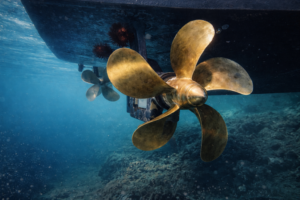
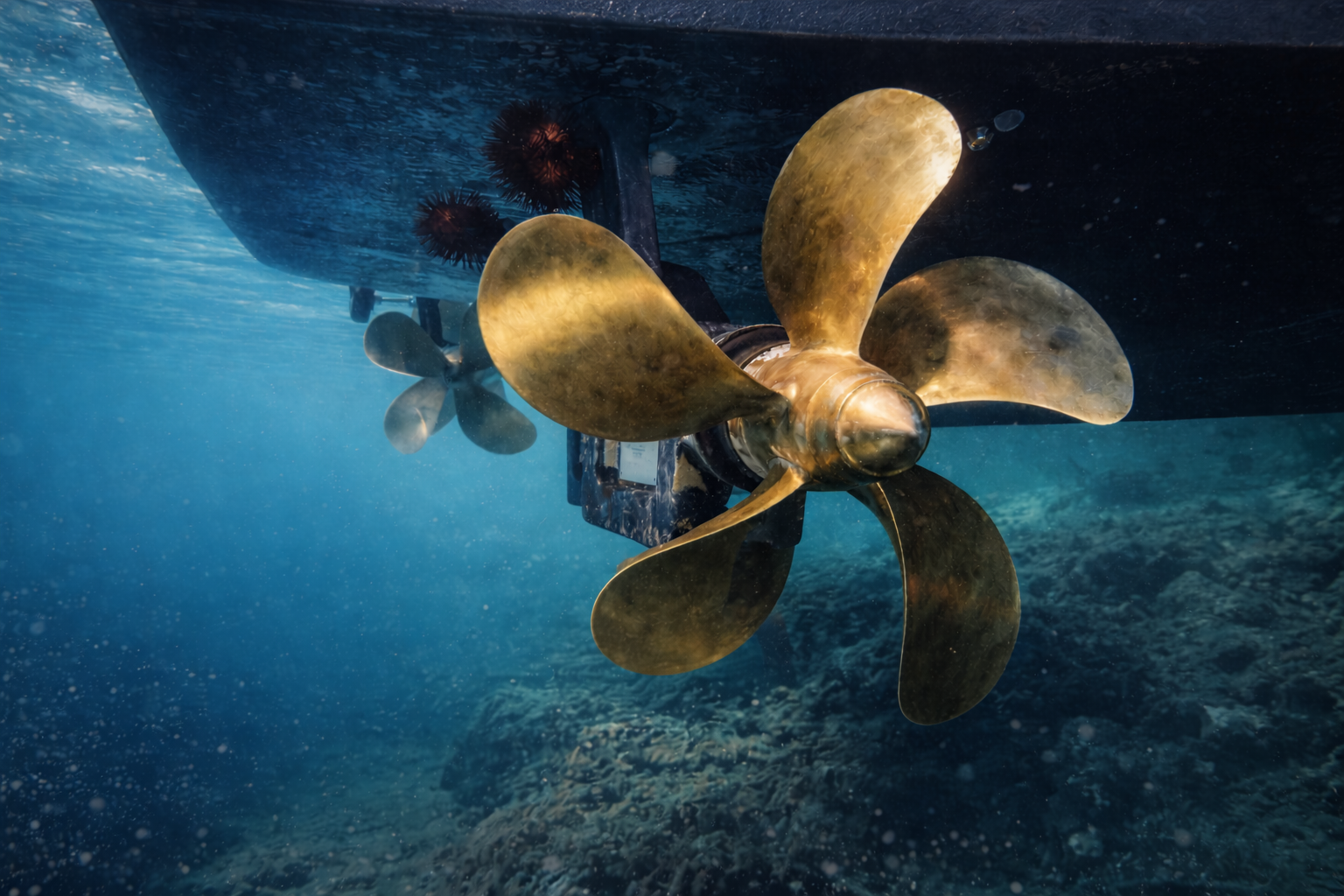
Underwater metal components — propellers, shafts, rudders, thrusters, stabilizers — operate in high-flow environments. They are exposed to hydrodynamic stress, cavitation forces, and mechanical cleaning. Any coating system must tolerate these loads without peeling, cracking, or delaminating.
Multi-layer systems can struggle under these conditions, particularly if intercoat adhesion weakens.
Single-film architecture simplifies the stress path. There is no primer-to-topcoat bond to compromise. When properly applied, the film behaves as a cohesive unit designed to remain intact under operational forces.
This translates into fewer emergency strip cycles and more predictable maintenance planning.
Renewal Without Reconstruction
Perhaps the most significant advancement lies in renewal methodology.
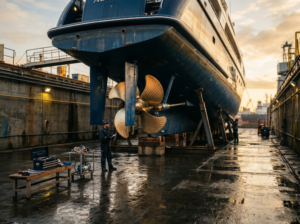
Conventional systems often require blasting or aggressive stripping before reapplication. This not only increases labor and downtime but also gradually erodes substrate thickness — particularly critical for propellers and precision-machined components.
Single-application renewable systems change that equation.
When designed correctly, new coating can integrate with existing film following light surface preparation. Instead of reconstructing the system from bare metal, operators reinforce it. This continuity-based renewal preserves substrate integrity and reduces lifecycle cost.
The system evolves — it does not restart.